
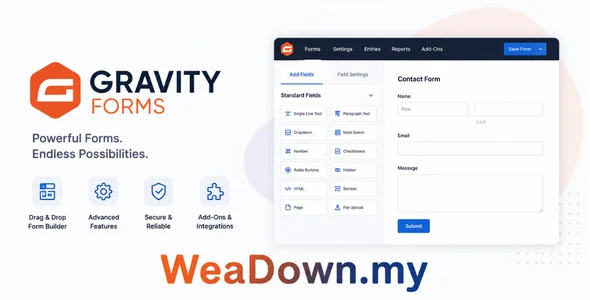
Gravity Forms Nulled is a premium WordPress form builder designed for much more than basic contact forms. It provides a flexible drag-and-drop environment for creating everything from simple inquiry forms to complex registrations, applications, surveys, payment forms, order forms, quizzes, file-upload forms, and automated business workflows.
The plugin stores submitted entries directly within WordPress, giving website owners a centralized place to review and manage collected information. More advanced functionality can be added through Gravity Forms’ official add-ons, including payment processors, email marketing services, CRM platforms, automation tools, user registration, surveys, polls, quizzes, and other integrations.
Gravity Forms is particularly popular with developers, agencies, businesses, educational organizations, nonprofits, membership websites, and other WordPress projects where form submissions need to do more than simply send an email.
Why Choose Gravity Forms?
One of the main reasons to choose Gravity Forms is flexibility. A basic form can be created quickly with the visual builder, but the same plugin can also support conditional workflows, calculations, payments, dynamically routed notifications, multi-page forms, API integrations, and custom development.
Conditional logic is especially useful for creating forms that adapt according to user responses. Instead of presenting every possible field at once, questions and sections can appear only when they become relevant.
Gravity Forms also has a mature add-on ecosystem. This allows businesses to connect form submissions with external services or trigger actions such as adding subscribers to mailing lists, processing payments, registering WordPress users, creating content, or forwarding information to another application.
For developers, its extensive API, REST API, actions, filters, webhooks, and Add-On Framework provide considerable room for customization.
Main Benefits
Flexible Form Creation
Gravity Forms can handle simple contact forms as well as complex data-collection workflows, reducing the need to use separate form plugins for different purposes.
Visual Drag-and-Drop Builder
Fields can be added and rearranged visually, allowing users to build forms without manually writing HTML for every input.
Advanced Conditional Logic
Show or hide fields, sections, and pages according to visitor responses, allowing forms to become more personalized and easier to complete.
Built-In Entry Management
Submitted information is stored inside WordPress, where administrators can review, filter, manage, and export entries.
Powerful Integrations
Official and third-party add-ons connect Gravity Forms with payment processors, CRMs, email marketing systems, automation tools, and other services.
Developer-Friendly Architecture
APIs, hooks, filters, webhooks, and development frameworks make Gravity Forms suitable for websites requiring custom integrations and workflows.
Suitable for Business-Critical Forms
Applications, registrations, payments, surveys, lead-generation forms, and other important processes can all be managed through the same core system.
Key Features
1. Drag-and-Drop Form Builder
Gravity Forms provides a visual form editor that allows fields to be placed and arranged through a drag-and-drop interface.
Website owners can begin with a blank form or use one of the available form templates as a starting point.
The builder also supports multi-column layouts, allowing several related fields to be displayed within the same row when appropriate.
2. 30+ Form Fields
The plugin includes more than 30 field types for collecting different types of information.
These fields can cover basic text, names, email addresses, phone numbers, addresses, dates, selections, uploads, pricing information, and other structured data.
Because fields have their own settings and validation options, administrators can configure forms around specific business requirements instead of treating every submission as generic text.
3. Conditional Logic
Conditional logic is one of Gravity Forms’ most powerful features.
Fields, sections, pages, notifications, and other supported elements can respond according to choices made by the visitor.
For example, a service inquiry could ask additional questions only when a particular service is selected. A registration form could display different options according to membership type, while a quote form could adjust the questions depending on the project.
This helps keep complicated forms cleaner and more relevant.
4. Multi-Page Forms and Save & Continue
Long forms can become intimidating when every field is displayed on a single page.
Gravity Forms allows larger forms to be divided into multiple pages, making applications, surveys, registrations, and onboarding forms easier to navigate.
Save & Continue functionality can also allow visitors to save their progress and return later rather than completing a lengthy form in one session.
This can be particularly useful for job applications, detailed project briefs, admissions forms, and other workflows requiring substantial information.
5. Calculations and Dynamic Forms
Gravity Forms supports calculations within form fields.
Values can be calculated dynamically according to mathematical formulas and user selections. This makes the plugin useful for quote calculators, order forms, pricing estimators, donation forms, registration fees, and similar use cases.
Merge Tags provide another layer of dynamic functionality by allowing submitted values and other information to be inserted into notifications, confirmations, and supported content.
6. File Uploads and Data Collection
File Upload fields allow visitors to send documents, photographs, PDFs, resumes, and other supported files through a form.
This can be useful for recruitment websites, support systems, application forms, project submissions, design briefs, and customer onboarding.
Submitted entries are stored within WordPress and can be reviewed through the Entries interface.
Administrators can also export entry data when information needs to be analyzed or processed outside WordPress.
7. Email Notifications and Routing
Gravity Forms provides flexible notification controls.
Different emails can be sent according to the information submitted by a visitor. Conditional routing makes it possible to direct inquiries to different employees, departments, or workflows based on selections made within the form.
For example, a company could route sales inquiries to one email address and technical support requests to another.
Custom confirmations can also be displayed or visitors can be redirected after successful submission.
8. Payment Forms and Recurring Payments
Gravity Forms can be extended with official payment integrations to create payment-enabled forms.
Supported add-ons include integrations with payment processors such as Stripe and other available providers, depending on the Gravity Forms license and add-on configuration.
Businesses can use these capabilities for orders, event registrations, donations, service payments, subscriptions, and recurring-payment workflows.
Discount codes and other commerce-oriented functionality are also available through supported add-ons and license levels.
9. Surveys, Quizzes, Polls and User Registration
Gravity Forms can extend beyond conventional contact and lead forms.
Available add-ons can transform forms into surveys, quizzes, polls, and user-registration workflows.
Survey functionality can collect structured feedback, while quizzes can include grading and scoring. Polls provide another way to collect audience opinions.
User Registration functionality can create WordPress accounts based on submitted form information, which is particularly useful for membership sites, communities, directories, and private portals.
10. APIs, Webhooks and Integrations
Gravity Forms is highly extensible for developers and automation workflows.
Its REST API can be used to manage forms and entries programmatically, while webhooks allow submitted data to be sent to external services and custom endpoints.
Gravity Forms also provides hundreds of WordPress actions and filters for developers who need to modify form behavior.
Official add-ons integrate forms with email marketing platforms, CRMs, payment processors, automation services, and other business tools. Third-party developers further expand the ecosystem with additional functionality.
Real World Use Cases
For business websites, Gravity Forms can handle contact forms, quote requests, lead-generation forms, customer onboarding, support inquiries, and service applications. Conditional routing can automatically send different inquiries to the appropriate department.
Recruitment websites can create detailed job application forms with personal information, experience fields, conditional questions, and resume uploads. Applications can then be stored and managed directly within WordPress.
For event organizers, Gravity Forms can create event registration forms that collect attendee information and, with appropriate add-ons, process registration payments.
Educational organizations can use the plugin for enrollment forms, student applications, quizzes, surveys, registrations, feedback forms, and document submissions.
For nonprofit organizations, Gravity Forms can support volunteer applications, contact forms, surveys, and payment-enabled donation workflows.
Membership and community websites can use the User Registration functionality to collect member information and create WordPress accounts automatically.
Developers and agencies can also build custom business workflows where submitted data is routed to CRMs, automation platforms, APIs, or other internal systems.
Frequently Asked Questions
What is Gravity Forms?
Gravity Forms is a premium WordPress form builder used to create contact forms, registrations, applications, surveys, payment forms, quizzes, order forms, file-upload forms, and other data-collection workflows.
Does Gravity Forms have a drag-and-drop builder?
Yes. Gravity Forms includes a visual drag-and-drop editor for creating and arranging fields without manually coding the complete form.
How many fields does Gravity Forms include?
Gravity Forms currently provides more than 30 form field types, with additional specialized functionality available through add-ons.
Does Gravity Forms support conditional logic?
Yes. Conditional logic can show or hide fields, sections, pages, and other supported elements according to user responses.
Can users save an unfinished form?
Yes. Gravity Forms includes Save & Continue functionality that can allow users to save their progress and return to the form later.
Can Gravity Forms accept payments?
Yes. Payment processing is available through supported Gravity Forms add-ons. Available processors and functionality depend on the installed add-ons and license level.
Can Gravity Forms create surveys and quizzes?
Yes. Survey, Quiz, and Poll functionality is available through applicable Gravity Forms add-ons.
Can Gravity Forms register WordPress users?
Yes. The User Registration Add-On can be used to create WordPress user accounts from form submissions.
Where are Gravity Forms submissions stored?
Form submissions are stored as entries within the WordPress website’s database and can be viewed and managed from the WordPress dashboard.
Can developers integrate Gravity Forms with external applications?
Yes. Gravity Forms provides a REST API, webhooks, extensive hooks and filters, and an Add-On Framework for building custom integrations and workflows.
Download Gravity Forms WordPress Plugin
You can download Gravity Forms from our website for testing and educational purposes. The package allows you to explore its drag-and-drop builder, conditional logic, multi-page forms, entry management, calculations, notifications, file uploads, and other core functionality on a compatible WordPress installation.
Some advanced Gravity Forms capabilities require official add-ons and an appropriate active license. These can include specific payment integrations, surveys, quizzes, polls, conversational forms, user registration, geolocation, partial entries, and other advanced functionality.
For a live production website, use a properly licensed and current version of Gravity Forms so you can receive official updates, compatibility fixes, documentation, support, and access to the add-ons included with your license.
Installation Guide
Getting started with Gravity Forms is straightforward:
- Log in to your WordPress administration dashboard.
- Navigate to Plugins → Add New → Upload Plugin.
- Select the Gravity Forms ZIP file.
- Click Install Now.
- Activate Gravity Forms after installation.
- Open Forms from the WordPress dashboard.
- Create a new form or begin with an available template.
- Add the fields required for your workflow.
- Configure validation and conditional logic where necessary.
- Set up confirmation messages or redirects.
- Configure administrator and customer email notifications.
- Install official add-ons if your workflow requires payments, marketing integrations, surveys, registrations, or other advanced functionality.
- Embed the finished form into a page or post using the Gravity Forms block or supported embedding method.
- Submit several test entries.
- Verify notifications, conditional logic, file uploads, calculations, and integrations.
- Test the form on desktop and mobile devices before publishing it publicly.
When forms collect important customer or business information, also review privacy, security, data-retention, spam-protection, and backup procedures before deploying them on a production website.
Final Thoughts
Gravity Forms is one of the more flexible form-building platforms available for WordPress because it can scale from a straightforward contact form into a much more advanced data-collection and automation system.
Its drag-and-drop builder, 30+ fields, conditional logic, multi-page forms, Save & Continue functionality, calculations, file uploads, entry management, and notification routing provide a strong foundation without requiring extensive custom development.
The wider add-on ecosystem is where Gravity Forms becomes particularly powerful. Payments, email marketing, user registration, surveys, quizzes, polls, CRM integrations, automation platforms, webhooks, and custom API workflows allow form submissions to become part of broader business processes instead of simply generating emails.
For businesses, agencies, developers, educational institutions, nonprofits, membership websites, and other WordPress projects where forms play an important operational role, Gravity Forms provides a mature and extensible system that can grow considerably beyond basic contact-form requirements.